Nebius’s Billion-Dollar Gamble: A Growth Rocket or a Financial Time Bomb?
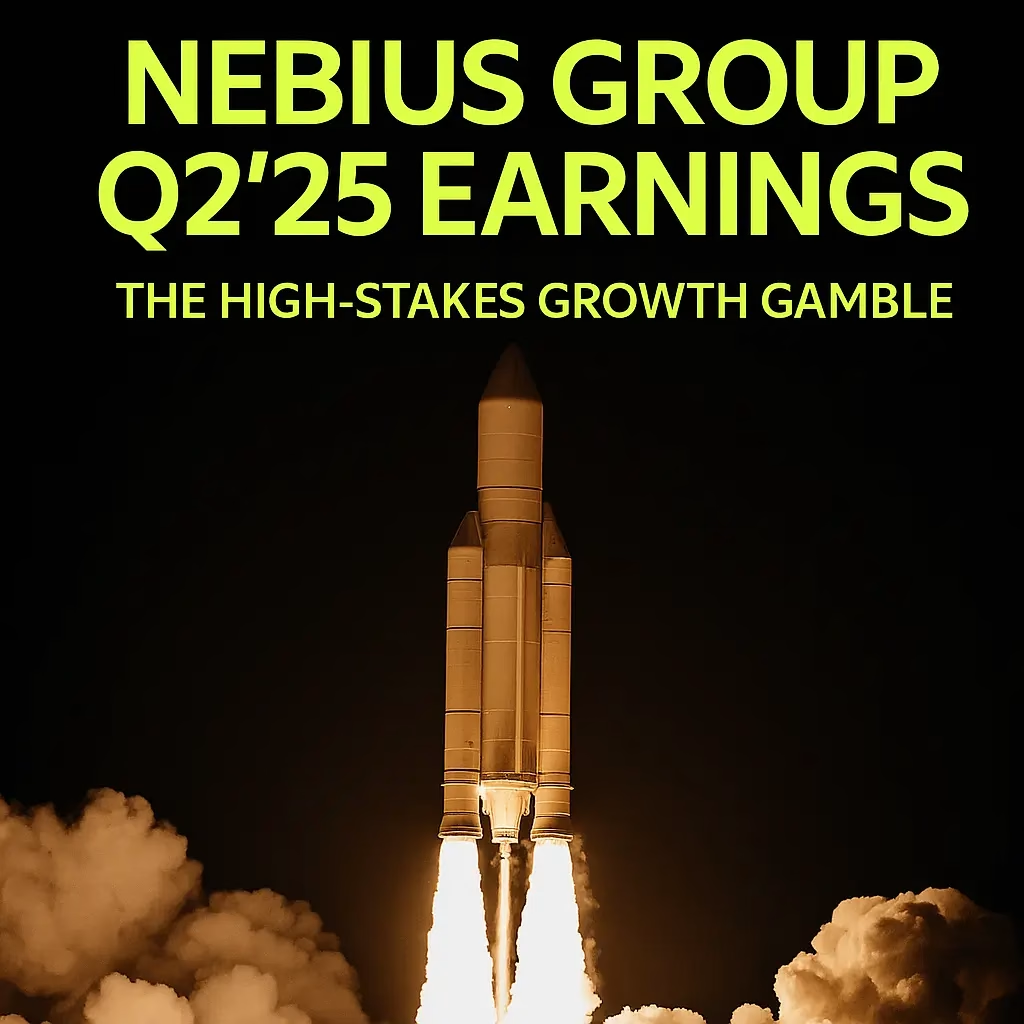
Every financial report placed before us by the markets is, in reality, a case file. The numbers are the cold, distant witnesses; our job is to interrogate them to uncover the real story behind the scenes. The Q2 2025 file for Nebius Group is precisely this kind of case, containing both the promise of a dazzling victory and a hidden peril. At first glance, the 625% explosion in revenue looks like a heroic epic destined for headlines. It’s the clearest evidence that the company is at the epicenter of the AI revolution, firing on all cylinders to meet demand.
However, detective work means never trusting the first clue. Before the ink on that brilliant headline has dried, a whisper from the balance sheet’s depths catches our attention: rising debt, dwindling cash reserves, and a colossal amount of money being burned from operations. Why is the group as a whole still burning cash from its coffers when its core business has turned a profit for the first time? Is the massive reported net profit a genuine operational triumph, or is it a masterful accounting illusion?
This analysis offers a key to unlock the complex case file Nebius has presented. Our goal isn’t just to list the numbers; it’s to decode the company’s strategic DNA, to understand what fuels this growth engine, and to determine whether this fire will lead the company to a bright future or an uncontrolled inferno. Are we looking at the next tech giant, or a bright star at risk of becoming a victim of its own ambition? Let’s piece together the evidence and seek the answer.
Key Financial Data
| Metric | Q2 2024 | Q2 2025 | Change |
| Revenue | $14.5 Million | $105.1 Million | +625% |
| Gross Profit Margin | 46.9% | 71.4% | +24.5 pp |
| Net Income (Continuing Ops.) | ($116.9) Million | $502.5 Million | Turned Positive |
| Cash Flow from Operating Activities | ($14.5) Million | ($105.1) Million | -625% |
| Total Debt / Equity | 0.18% | 26.1% | +25.9 pp |
The Case’s X-Ray: The Numbers’ First Confessions
The table above starkly reveals the core conflict in the Nebius story: a knife-edge balance between operational strength and financial strain. A more than sevenfold increase in revenue and a jump in gross profit margin from 47% to 71% prove how valuable the company’s AI infrastructure services are and that it possesses significant pricing power. This is concrete proof that the “core business” is working and its efficiency is improving with scale.
But the other side of the coin is darker. The fact that the operational cash burn increased at the same rate as revenue (+625%) is an alarm bell. This indicates that for every $1 in sales, the company burned approximately $1 in operational cash. This confesses that the growth is not yet “self-funding”; on the contrary, it’s increasing its dependence on external capital. Similarly, a debt-to-equity ratio that was near zero suddenly climbing to 26% shows the company has added a significant risk element to its balance sheet to satisfy its appetite for growth. The record-breaking reported profit, almost entirely due to a one-time “revaluation of investment” gain, offers a deceptive sheen that is far from reflecting operational reality.
Deep Dive Diagnosis: Assembling the Evidence
To prove our main thesis of “High-Risk Growth,” let’s use three primary tools: The Three Legs of Cash Flow, the Debt Structure, and the Layers of Profitability.
The Three Legs of Cash Flow: Where Does the Money Come From, and Where Does It Go?
A company’s cash flow is its lifeblood. We can examine this circulation through three main arteries: Operations, Investing, and Financing.
-
Cash Flow from Operations: Shows how much cash the core business generates.
-
What the Data Says: Nebius burned -$105.1 million from its operations this quarter.
-
What It Means Strategically: This is a sign of growing pains. Rapid expansion often creates working capital needs, like rising receivables and inventory. Nebius’s operations are not yet able to convert paper profits into hard cash.
-
-
Cash Flow from Investing: Shows purchases (CAPEX) and sales of assets.
-
What the Data Says: The company made a staggering -$510.6 million in capital expenditures (GPU purchases and data center expansions) this quarter.
-
What It Means Strategically: This is the heart of the story. Management is making a massive infrastructure investment today to meet future demand. It’s an aggressive and bold move to capture market share, but it also causes a huge cash drain from the company’s treasury.
-
-
Cash Flow from Financing: Shows activities like borrowing money or issuing stock.
-
What the Data Says: The balance sheet shows approximately $978 million in new long-term debt. This was used to cover the combined cash deficit of over $600 million from operations and investments, and to create a buffer for future spending.
-
What It Means Strategically: Nebius is fueling its growth rocket with debt. This is the fastest way to grow, but it also reduces financial flexibility and adds an interest burden.
-
| Cash Flow Category | Q2 2025 Impact ($ Million) | Strategic Action |
| Operating Activities | -105.1 | Operational cash deficit caused by rapid growth |
| Investing Activities | -510.6 | Aggressive infrastructure spending (CAPEX) for the future |
| Financing Activities | ~+980 | New debt taken on to close the cash gap |
The Big Picture: Industry, Competition, and Future Scenarios
Evaluating Nebius’s aggressive strategy in a vacuum would be misleading. The AI infrastructure sector is a capital-intensive industry dominated by “winner-take-all” dynamics. With giants like Amazon (AWS), Microsoft (Azure), and Google (Cloud) investing billions, it’s almost a necessity for a new player like Nebius to show similar audacity to secure a foothold. From this perspective, management’s move is not one of panic but a calculated risk to stay in the race.
This is also where our counter-thesis comes into play: perhaps this borrowing and cash burn is the “entry fee” required to establish a permanent place in the market’s most profitable segment. If Nebius can prove its technological superiority and economies of scale with these investments, it could easily manage this debt with future high-margin revenues. However, the failure scenario is just as plausible: if demand grows slower than expected or if pricing pressure from competitors erodes margins, the company could find itself in a debt spiral. The key question for investors is: Is Nebius racing to win the AI war, or just sprinting until it runs out of breath?
The Analyst’s Scorecard: Performance Ratings
-
Balance Sheet Health (4/10): While the cash position is strong, the new and significant debt load adds a serious risk. (Total Debt/Equity ratio’s jump from 0.18% to 26.1%)
-
Profitability (6/10): Gross margins are impressive and the core business’s positive adjusted EBITDA is promising, but the group is still loss-making, and the reported net profit is based on a one-off gain. (Gross margin rising to 71.4%)
-
Cash Flow Strength (2/10): Intense cash burn from both operations and investing activities. This is the company’s weakest point. (Operating cash flow of -$105.1 million)
-
Quality of Growth (7/10): Revenue growth is extraordinary and reflects market demand, but this growth is not yet organic or self-funding. (Revenue growth of +625%)
-
Risk Management (5/10): Management is taking a calculated risk for growth, but this makes the company more vulnerable to macroeconomic shocks or interest rate hikes. (New $978 million in debt)
-
Efficiency (7/10): The increase in gross profitability as scale increases indicates that operational efficiency is improving. (Gross margin increased by 24.5 percentage points)
-
Competitive Position (8/10): Its leading position in AI infrastructure and technological capabilities give it a strong competitive advantage. (MLPerf benchmark results and major client wins)
-
Management Vision (9/10): Management has a clear vision for the future of the market and is not afraid to take bold steps to realize it. (The 1 GW power target)
Total Score: (48/80)
The Ultimate Litmus Test: Is the Company Creating Value? (ROIC Analysis)
Return on Invested Capital (ROIC) measures the power of a company’s value-creation engine. In Nebius’s current state (negative operating income), its ROIC would be negative. This means the company is not earning a return above its cost of capital (WACC); technically, it is consuming value today for the potential to create immense value in the future. The investment thesis hinges on the expectation that today’s negative ROIC will transform into an industry-beating ROIC driven by future investments.
Conclusion: Strategic Takeaways & Watchlist for Investors
Nebius’s Q2 report presents a complex picture for investors who are still in the early chapters of the story. It’s neither a clearly “good” nor a clearly “bad” report; it is, rather, the financial statement of a high-risk, high-reward strategic gamble.
3 Strategic Takeaways:
-
The Growth Thesis Is Confirmed: Nebius has proven its ability to capitalize on the demand in the AI market. There is no concern about growth.
-
Financial Risk Has Increased: The growth is being funded with debt, significantly increasing the company’s financial fragility.
-
Profitability Is on the Horizon: The core business reaching positive adjusted EBITDA is the first tangible sign that the profitability potential is not just theoretical but an achievable goal.
Investor’s Watchlist (For the Next Quarter):
-
Operating Cash Flow: Watch to see if the negative trend slows down. Is the cash burn rate growing slower than the revenue growth rate? This is the single most critical metric to monitor.
-
Adjusted EBITDA (at Group Level): Can the profitability in the core business start to offset losses in other units, bringing the group level closer to breakeven?
-
New Customer Announcements & Capacity Utilization Rates: Track how quickly the massive investments are being filled with customers and revenue. Management’s commentary will be crucial here.
The Analyst’s Desk: FAQs
-
Risk Radar (The Most Critical Risk): “Is this level of cash burn and debt sustainable?”
-
Answer: In the short term, yes. The company still has $1.68 billion in cash. However, at the current burn rate (approx. $600 million per quarter including operations and investing), this buffer could deplete quickly. Sustainability depends on the company’s ability to convert revenues into cash faster and/or secure additional financing. What this means for you is: while investing in the growth story, you must constantly check the fuel gauge and know where the next gas station is (a new financing round or a turn to profitability).
-
-
Opportunity Window (The Biggest Potential): “What does it mean that the core business has become profitable?”
-
Answer: This is the pivot point of the entire investment thesis. It’s the first concrete proof that the Nebius business model works in practice, not just in theory. It shows that as scale increases, costs rise slower than revenues, creating the potential for huge profit margins in the future. An investor should read this as the first step in shifting the question from “if” to “when” regarding profitability and should closely monitor every percentage point increase in the adjusted EBITDA margin.
-
-
Technical Deep Dive (Under the Lens): “Why is the reported $502 million net profit misleading?”
-
Answer: Think of this profit like the income you’d get from selling your house. It makes your income for that year look very high, but it doesn’t mean your salary increased or that it’s a recurring event. Nebius’s profit comes from a $597 million “revaluation of investment”—a paper gain on an asset it holds. It does not reflect its operational performance. The detail that changes the big picture is this: when you exclude this one-off gain, the company is still operationally unprofitable.
-
-
Strategy Room (At the Management Table): “Why is management so focused on growth instead of profitability?”
-
Answer: Management views the AI infrastructure market like a highway network being built. Right now, the goal is to claim the most strategic routes (market share). Once the highway is complete and everyone starts using it, they will begin collecting the tolls (profits). If they stop now to focus on profits, competitors might seize all the valuable routes. This is an “all or nothing” strategy. In the success scenario, they become an indispensable player. In the failure scenario, they will have built an expensive highway that nobody uses.
-
-
Market Pulse (Stock Price Expectation): “How might this report affect the stock price?”
-
Answer: The market often reacts to such reports with a split decision. Short-term traders and growth-focused funds might see the record 625% revenue growth and increased ARR guidance as a “buy” signal, pushing the stock up. Value investors and more risk-averse funds might focus on the increasing cash burn and debt, viewing it as a “sell” or “wait-and-see” moment. The stock price in the short term will be a battle between these two camps. In the medium term, the direction will be determined by how successfully the company improves the metrics on the “Investor’s Watchlist.”
-
The Challenge: It’s Your Turn to Analyze
These are the clues we’ve pieced together and the conclusions we’ve drawn from this case file. But the best analysis is enriched not by a single expert’s opinion, but by collective intelligence.
-
Do you see the massive debt, which we’ve labeled a “risk,” as a brilliant “investment opportunity” to capture the market?
-
Is there a critical footnote or data point regarding the core business’s profitability that you think we’ve overlooked?
If you disagree with this analysis or have an insight to add, we invite you to “play devil’s advocate” in the comments and challenge us with your own thesis.
Legal and Ethical Framework
The information, comments, and recommendations contained herein do not fall within the scope of investment advisory. Investment advisory services are provided by brokerage houses, portfolio management companies, non-deposit banks, and clients under an investment advisory agreement. The views and opinions expressed on this site and in this article are for informational and educational purposes only and may not be sufficient for your personal investment decisions. The analyses provided may not be suitable for your financial situation and risk-return preferences. Therefore, making an investment decision based solely on the information contained herein may not yield results that meet your expectations. The analyses in this article reflect the original interpretations and methodology of etrefinans.com on publicly available financial reports. While utmost care has been taken to ensure the accuracy of the data used in the analyses, etrefinans.com cannot be held responsible for any losses that may arise from potential errors and omissions.
Join the Discussion
I also share real-time assessments of this analysis and other market commentary on my X (Twitter) account. To continue the discussion there and stay informed about the latest analyses, you can follow me at: https://x.com/y_etreabc