Palantir’s Q2 2025 Earnings: Not Just Growth, A Show of Force
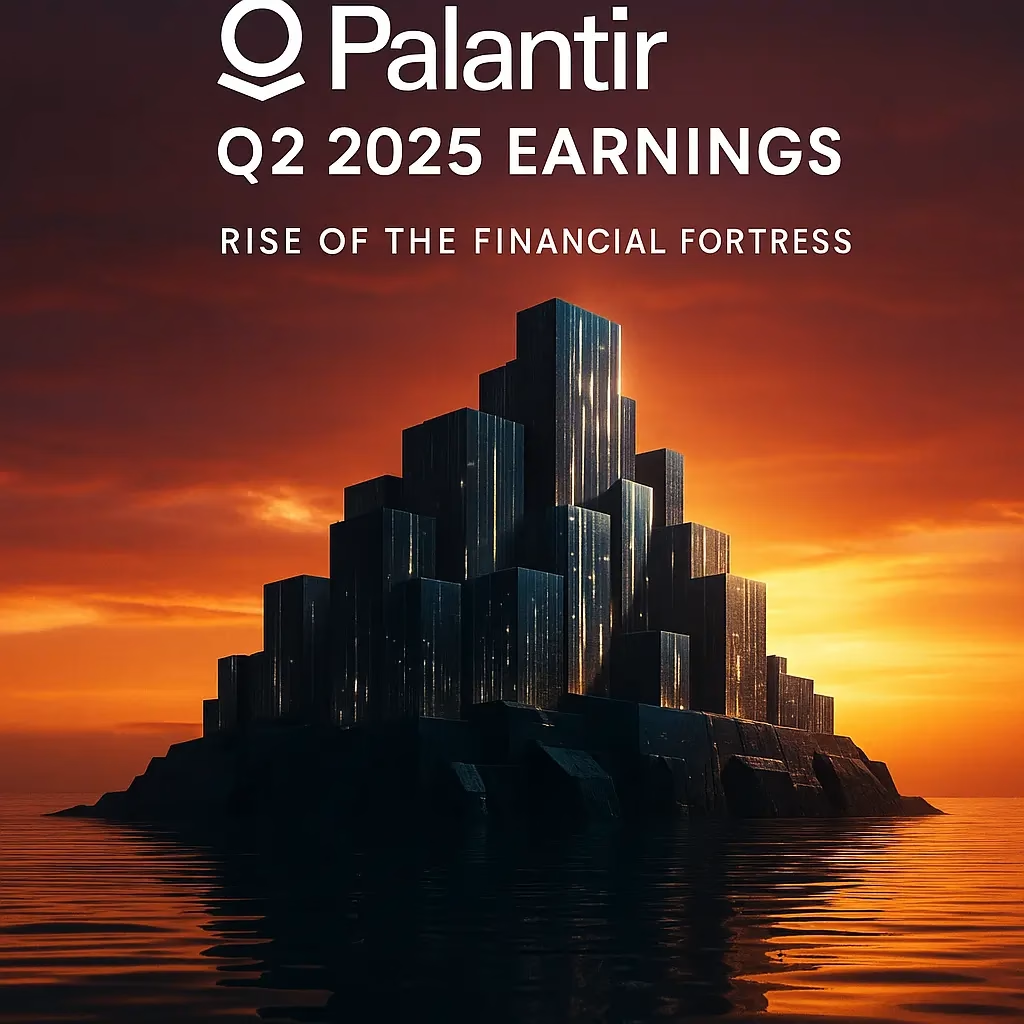
Financial markets often gravitate toward headline-grabbing stories: dizzying growth rates, record revenues, and crushed earnings expectations. At first glance, Palantir’s (PLTR) second-quarter 2025 results deliver on these fronts, boasting a 48% year-over-year revenue increase. For any tech company, this is a commendable achievement. However, as we open this case file, we find that the real story isn’t in the headlines, but hidden between the lines. This isn’t just a growth report; it’s a declaration of strategic dominance and the completion of a financial fortress.
The central mystery of our case file is this: how can a company grow by nearly 50% while simultaneously causing its profitability to explode, filling its coffers with billions, and managing to avoid a single penny of financial debt on its balance sheet? This scenario is either a financial illusion or, more compellingly, evidence of a business model so potent it should alarm competitors and enlighten investors.
In this analysis, we will examine Palantir’s financial statements with forensic precision. We won’t just ask “what happened,” but “what does this mean,” and more importantly, “is it sustainable?” From the operational efficiency driving its margin expansion to the disciplined path its cash flow travels, we will reveal the true picture behind the curtain. By the time this file is closed, you will have a clear verdict on whether Palantir is merely a growing company or a financial powerhouse ascending to a new league.
Key Financial Data
| Metric | Q2 2024 ($M) | Q2 2025 ($M) | Change (%) |
| Revenue | 678.1 | 1,003.7 | +48% |
| Gross Profit Margin | 81% | 81% | 0 pp |
| Net Income | 134.1 | 326.7 | +144% |
| Op. Cash Flow (6-Month) | 273.8 | 849.5 | +210% |
| Net Debt / Equity | 0 | 0 | 0 pp |
The Autopsy of the Numbers: First Confessions
The data in the table offers telling confessions under initial interrogation. The healthy 48% revenue growth is just the beginning of the story. What truly commands attention is the astronomical 144% leap in Net Income. This indicates that for every new dollar of revenue, the company is generating far more profit than before. In financial parlance, this is called “operating leverage,” and it’s the clearest proof of how scalable Palantir’s software-based business model has become. While the stable 81% gross margin confirms that the cost of goods sold is under control, the explosion in net income reveals how slowly operating expenses are growing relative to the revenue surge. This is a masterclass in efficiency.
However, the most powerful confession comes from the cash flow and debt columns. Over a six-month period, the cash generated from core operations. This proves the profits aren’t just an accounting entry; they represent real, tangible cash hitting the bank account. These high-quality earnings, combined with the zero financial debt on the balance sheet, underscore the rock-solid foundation of Palantir’s financial health.
Deeper Diagnosis: Assembling the Evidence
Profitability Margins: The Efficiency Engine Ignites
Palantir’s story is now one of margin expansion. Let’s examine the evolution of its margins compared to last year:
| Margin Type | Q2 2024 | Q2 2025 | Change (Basis Points) |
| Gross Profit Margin | 81.0% | 81.0% | 0 bp |
| Operating Profit Margin | 15.5% | 26.8% | +1130 bp |
| Net Profit Margin | 19.8% | 32.5% | +1270 bp |
Strategic Implication: The flat gross margin shows the product cost is contained. However, the colossal 11-12 percentage point jump in Operating and Net Profit margins proves the company is fully capitalizing on economies of scale. The marginal cost of acquiring a new customer is plummeting. This is the “holy grail” of the software business model, and Palantir appears to have reached this stage. The company no longer needs to spend disproportionately on marketing or administrative costs to generate revenue. The growth engine has transformed into a self-fueling efficiency dynamo.
The Three Legs of Cash Flow: A Self-Sufficient Empire
A company’s cash story is told in three parts: operations, investing, and financing. Palantir’s 6-month cash flow statement (Page 8) tells a clear tale:
-
Cash from Operations (+$849 Million): This is the heart of the empire. The company generates an immense amount of cash from its core business, demonstrating complete independence from external capital.
-
Cash from Investing (-$2 Billion): Where is this cash going? The footnotes (Page 8 & 34) reveal that a majority of this outflow was used to purchase highly safe and liquid assets like “short-term U.S. Treasury securities.” Palantir isn’t letting its cash sit idle; it’s putting it to work in low-risk instruments to generate additional income. This is a textbook “Financial Fortress” strategy.
-
Cash from Financing (-$22 Million): The silence on this front is the loudest message. The company is not raising debt or significant equity. The minor outflow is attributed to shareholder-friendly activities like share repurchases. In short, Palantir doesn’t need Wall Street to fund its ambitions.
The Fortress Walls: Zero Debt, An Ocean of Liquidity
Palantir’s balance sheet (Page 3) presents a landscape rarely seen in today’s tech world. It holds approximately $6 billion in cash and marketable securities against zero financial debt.
Strategic Implication: This is not merely an accounting detail; it’s a strategic weapon.
-
Defense: In an economic crisis, indebted companies crumble under interest payments. Palantir can weather the storm without a scratch.
-
Offense: When a competitor falters or a strategic acquisition opportunity arises, Palantir has a multi-billion-dollar war chest, giving it immense bargaining power.
-
Independence: It is insulated from interest rate hikes or credit market contractions. It is the master of its own destiny.
The Big Picture: Industry, Competition, and Future Scenarios
In a vacuum, Palantir’s financial picture looks flawless. However, when we zoom out, a potential concentration risk comes into focus: geographic and segmental dependency. The report clearly states that 72% of revenue comes from the United States, with U.S. commercial growth acting as the primary engine at a staggering 92.5%. While an impressive achievement, it also carries the risk of “putting all eggs in one basket.”
To play devil’s advocate, the potential weakness of this financial fortress may be its sensitivity to an economic or political downturn in the U.S. market. The company’s principled stance—such as its refusal to work with the Chinese Communist Party—strengthens its bonds with Western democracies but also limits its total addressable market. The sustainability of future growth will depend on whether it can replicate its U.S. success in other key markets, particularly in Europe and allied Asian nations.
The Analyst’s Scorecard: Performance Ratings
-
Balance Sheet Strength (10/10): Perfect. Zero financial debt and $6 billion in liquid assets (Cash & Marketable Securities) make it an outlier in the sector.
-
Profitability (9/10): Outstanding. The 1130 basis point expansion in Operating Margin is a testament to the company’s scalability and efficiency.
-
Cash Flow Strength (9/10): Very strong. Operating cash flow significantly exceeding net income confirms the highest quality of earnings.
-
Growth Quality (8/10): High-quality growth. Achieved organically and profitably, without taking on debt (48% revenue growth).
-
Risk Management (7/10): Good, but with room for improvement. Financial risks are managed flawlessly, but the high dependency on the U.S. market and commercial segment presents a strategic concentration risk.
-
Efficiency (9/10): Peak performance. While revenues grew by 48%, operating expenses rose by only 22% (Page 32), showing the company is operating like a well-oiled machine.
-
Competitive Position (8/10): Strong. Its entrenched position with government and large enterprise clients, along with its Artificial Intelligence Platform (AIP), provides a significant competitive moat.
-
Management Vision (8/10): Clear and consistent. The strategy prioritizes long-term, profitable growth on an ethical foundation over short-term gains.
Overall Score: (68/80)
The Ultimate Test: Is the Company Creating Value? (ROIC Analysis)
The fundamental question for any investor is: Does the company earn a higher return on its invested capital (ROIC) than its cost of that capital (WACC)?
While we don’t know Palantir’s exact WACC, its zero-debt structure significantly lowers its cost of capital. On the other hand, its exploding operating profitability and capital-light business model indicate a very high ROIC. It is reasonable to conclude that ROIC comfortably exceeds WACC, meaning the company is clearly creating significant value for its shareholders.
Conclusion: Strategic Takeaways & Investor Watchlist
This analysis shows that Palantir is no longer just a fast-growing adolescent but has matured into a financial titan. The balance sheet for this period is unequivocally excellent.
3 Strategic Takeaways:
-
Growth Is Now a Byproduct; Efficiency Is the Main Product: Palantir has solved the equation of turning revenue growth into exponential profit growth. Each new customer now contributes disproportionately to the bottom line.
-
The Balance Sheet Is a Strategic Weapon: Zero debt and $6 billion in cash provide Palantir with defensive resilience in crises and offensive power for future opportunities.
-
Earnings Quality Is Unimpeachable: Every dollar of reported profit is backed by tangible cash flowing into the company, boosting the credibility of its financial statements.
Investor Watchlist (For the Next Quarter):
-
Non-U.S. Commercial Revenue Growth Rate: This is the most critical metric to watch to see if the company is mitigating its geographic concentration risk.
-
Operating Profit Margin: Monitor whether the ~27% margin level is sustainable or if it can expand further, which is key to the continuing efficiency narrative.
-
Government Segment Revenue: While overshadowed by the commercial boom, the continued steady growth of this segment is crucial for revenue diversification.
From the Analyst’s Desk: FAQs
-
Risk Radar: In a balance sheet that looks this good, what is the most critical overlooked risk?
Answer: The most critical risk is the complacency and concentration that success creates. Palantir’s overwhelming success in the U.S. commercial segment could lead it to over-focus on this area at the expense of international expansion. For you, this means the stock is currently highly sensitive to the health of the U.S. economy and corporate spending. You should watch the non-U.S. revenue growth rate like a hawk next quarter. -
Opportunity Window: Where does the company’s greatest future potential lie?
Answer: The potential lies in the commercialization of its Artificial Intelligence Platform (AIP), mentioned throughout the report. The current efficiency gains come from scaling existing platforms. Widespread adoption of AIP would not only increase revenue from current clients but could open up entirely new markets and revenue streams. For investors, this represents an “option value” not yet fully reflected on the balance sheet. -
Technical Deep Dive: What exactly are the $5 billion in “Marketable Securities,” and do they carry risk?
Answer: Think of this as the company’s “high-yield savings account.” The footnotes (Page 12) clarify that nearly all of these assets consist of extremely low-risk and liquid instruments like U.S. Treasury securities. These are not risky stock investments. It is a smart cash management strategy to protect the company’s massive cash pile from inflation while earning a modest return. This is not a risk; it’s a sign of strong financial stewardship. -
The Strategy Room: Isn’t the company’s Western-centric focus and avoidance of markets like China a long-term disadvantage?
Answer: This is a cornerstone of Palantir’s strategy and a double-edged sword. Yes, they are sacrificing a potentially massive market. But by doing so, they are building irreplaceable, deep-rooted relationships with government agencies in the U.S. and allied nations (security, defense, intelligence). This creates a high-barrier “competitive moat” that rivals cannot easily penetrate. Management is choosing to be the leader in a narrower, deeper, and more profitable niche rather than a player in a vast, commoditized market. -
Market Pulse: How might this strong earnings report affect the stock price in the short term?
Answer: The market will likely have a multi-layered reaction. Growth-oriented investors will applaud the 48% revenue growth and the 92% U.S. commercial surge. Value and quality investors will focus on the exploding profit margins, strong cash flow, and pristine balance sheet, increasing their confidence. On the other hand, bears will continue to point to the high valuation and the U.S. dependency as risks. This report strengthens the bulls’ case and weakens the bears’ argument, but it won’t eliminate it entirely.
The Challenge: Your Turn to Analyze
These are the clues we’ve assembled and the conclusions we’ve drawn from this case file. But the best analysis is enriched not by a single expert’s opinion, but by collective intelligence.
-
Do you see an item we’ve flagged as a “risk” as an “investment opportunity” instead?
-
Is there a critical footnote or data point you think we’ve overlooked?
If you disagree with this analysis or have an insight to add, we invite you to play devil’s advocate in the comments and challenge us with your own thesis.
Legal & Ethical Framework
The information, comments, and recommendations contained herein are not within the scope of investment advisory. Investment advisory services are provided under an investment advisory agreement to be signed between intermediary institutions, portfolio management companies, non-deposit banks, and the client. The views and thoughts presented on this site and in this article are for informational and educational purposes only and may not be sufficient for your personal investment decisions. The analyses provided may not be suitable for your financial situation and risk-return preferences. Therefore, making an investment decision based solely on the information herein may not produce results in line with your expectations. The analyses in this article reflect the original interpretations and methodology of etrefinans.com on publicly available financial reports. Although maximum care has been taken to ensure the accuracy of the data used in the analyses, etrefinans.com cannot be held responsible for any losses that may arise from potential errors and omissions.
Join the Discussion
I share real-time assessments of this analysis and other market commentary on my X (Twitter) account. To continue the discussion there and stay updated on the latest analyses, you can follow me at: https://x.com/y_etreabc
Related articles
Bölümün tamamı →
Yorumlar
Soru, düzeltme ve karşı okuma için burası. İlk yorumunuz onaydan geçer.